

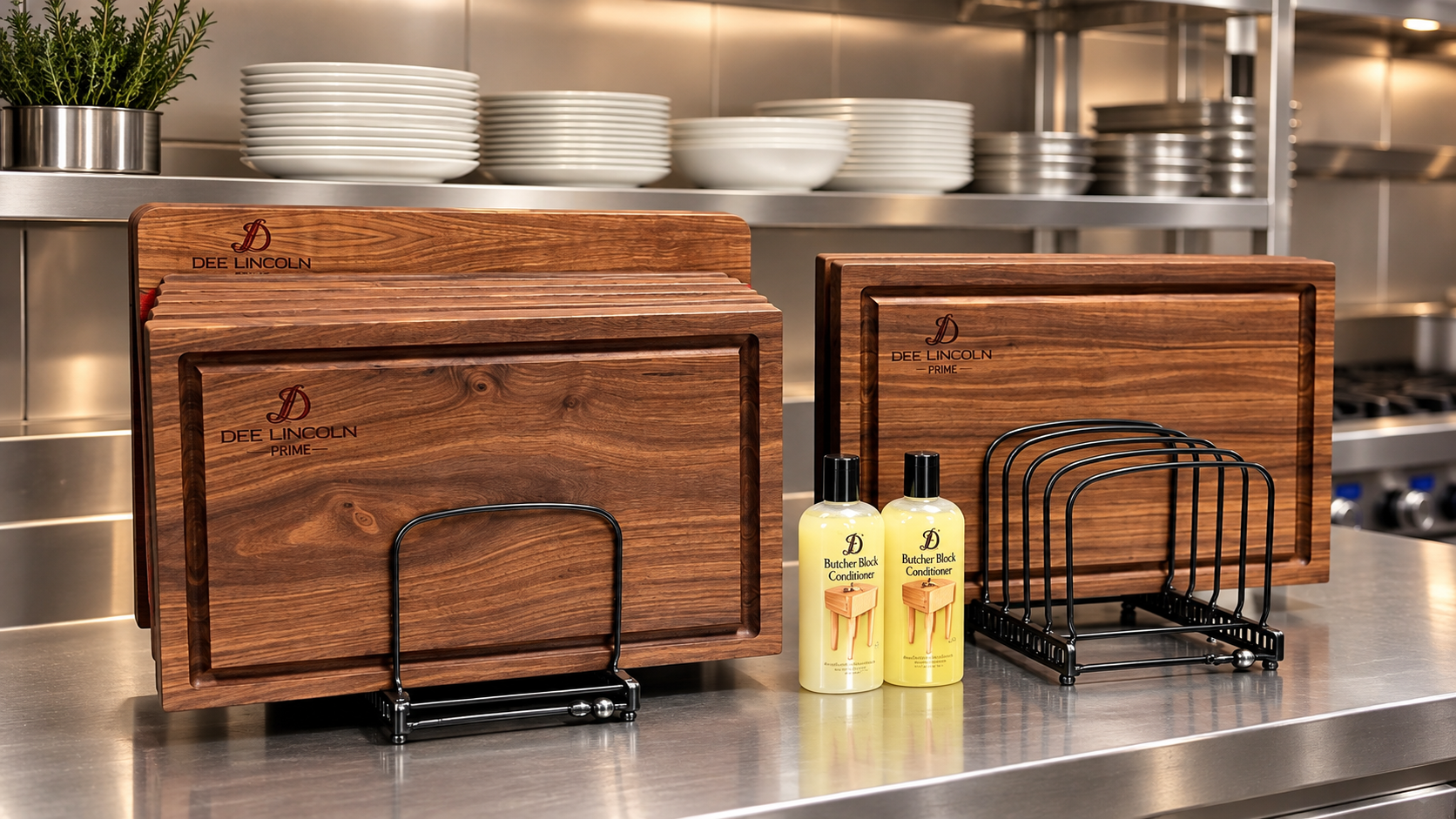
Why Restaurant Serving Boards Need to Be Designed Differently Than Home Cutting Boards
A beautiful wooden serving board can completely change the presentation of a dish.
But a board built for a restaurant, bar, hotel, or commercial kitchen shouldn't simply be a residential cutting board with a logo added to it.
Commercial serving pieces live a very different life.
They may be used dozens of times during a single service, carried across dining rooms, exposed to sauces and moisture, washed repeatedly, stacked, dropped, and put back into service the following day.
That means commercial boards need to be designed with durability, maintenance, presentation, and workflow in mind from the beginning.
Start With How the Board Will Actually Be Used
Before choosing wood species or dimensions, the first question should be:
What is going on the board?
A steak presentation board has different requirements than a charcuterie board.
A board used for brisket may need room for a substantial portion of meat along with sides and garnishes. A dessert presentation may require considerably less surface area.
The board should complement the food without overwhelming it.
It also needs to comfortably fit the restaurant's tables, server trays, dish stations, storage areas, and existing workflow.
A board that looks impressive in a photograph but creates problems during a busy Friday-night service isn't a successful design.
Thickness Matters
Residential cutting boards are often made thicker because customers like the substantial feel of a heavy butcher block.
That isn't always ideal in a restaurant.
Imagine a server carrying several heavy hardwood boards across a dining room hundreds of times each week. Adding unnecessary weight can quickly become a problem.
Commercial boards need enough thickness to remain durable and resist movement while avoiding unnecessary bulk.
There is no universal perfect thickness.
The correct answer depends on the board's dimensions, material, design, and intended use.
Wood Selection Should Be Practical
There are dozens of beautiful hardwood species available, but commercial environments aren't always the right place to select wood based entirely on appearance.
For frequently used restaurant boards, durability and maintenance are extremely important.
Walnut is particularly popular because of its rich color and upscale appearance. Maple provides a lighter, clean presentation. Other species can be incorporated when the design calls for something more distinctive.
The goal should be to choose materials that support the restaurant's overall presentation without creating unnecessary maintenance problems.
Juice Grooves Should Have a Purpose
A juice groove looks great on a cutting board, but in a restaurant it needs to perform.
For steaks, brisket, and other meats, a properly designed groove can help control juices and keep presentation cleaner.
But groove dimensions matter.
A groove that is too small may accomplish very little. A groove that is unnecessarily large removes valuable serving space and can make cleaning more difficult.
Commercial boards should be designed around the food rather than simply adding features because they are commonly found on cutting boards.
Branding Should Feel Intentional
A custom serving board gives restaurants an opportunity that ordinary plates don't provide.
The serving piece itself can become part of the brand.
Restaurant logos can be incorporated through engraving, carving, inlays, or other methods depending on the material and desired appearance.
But restraint matters.
A massive logo taking up the center of the board can compete with the food.
The best branding usually feels like it belongs there — visible enough for guests to notice and photographs to capture without becoming the focal point of the presentation.
When customers photograph a steak, cocktail presentation, charcuterie spread, or dessert and share it online, the serving board can quietly carry the restaurant's brand with it.
Think Beyond the First Day
A brand-new serving board is easy to make look good.
The real question is:
What will it look like after hundreds of services?
Commercial buyers should think about maintenance before ordering.
How will the boards be washed?
How will they be dried?
Where will they be stored?
How frequently will they need to be refinished?
Who will be responsible for maintaining them?
Those questions may influence everything from material selection to board thickness and design.
Consistency Matters When Ordering Multiple Boards
Restaurants rarely need one board.
They may eventually need six, twelve, twenty, or considerably more.
That makes repeatability extremely important.
Dimensions, logo placement, grooves, handles, corner profiles, and other features should be established so replacement boards can be produced as consistently as possible.
A successful commercial board becomes less of a one-time woodworking project and more of a product designed specifically for that restaurant.
Wooden Boards Aren't the Only Option
Depending on the application, hardwood may not always be the best solution.
Commercial kitchens and hospitality businesses may benefit from alternative materials designed for demanding environments.
Good Shepherd Woodshop also works with materials such as Richlite, a durable paper-composite material that can be CNC machined into custom prep surfaces, serving pieces, and hospitality products.
That gives restaurants another option when they like the appearance and customization possibilities of a fabricated board but have operational requirements that may not be ideal for traditional hardwood.
Custom Commercial Boards from Good Shepherd Woodshop
At Good Shepherd Woodshop, we design and manufacture custom serving boards, cutting boards, charcuterie pieces, branded hospitality products, and specialty fabricated pieces for restaurants and commercial clients.
Rather than starting with a predetermined board and trying to make it work, we can design around the food, presentation, dimensions, branding, and operational requirements of the business.
For restaurants, bars, hotels, caterers, private clubs, and other hospitality businesses, that means the finished product isn't simply a cutting board.
It's part of the presentation.
Interested in custom serving boards or commercial fabrication for your business? Contact Good Shepherd Woodshop to discuss your project.
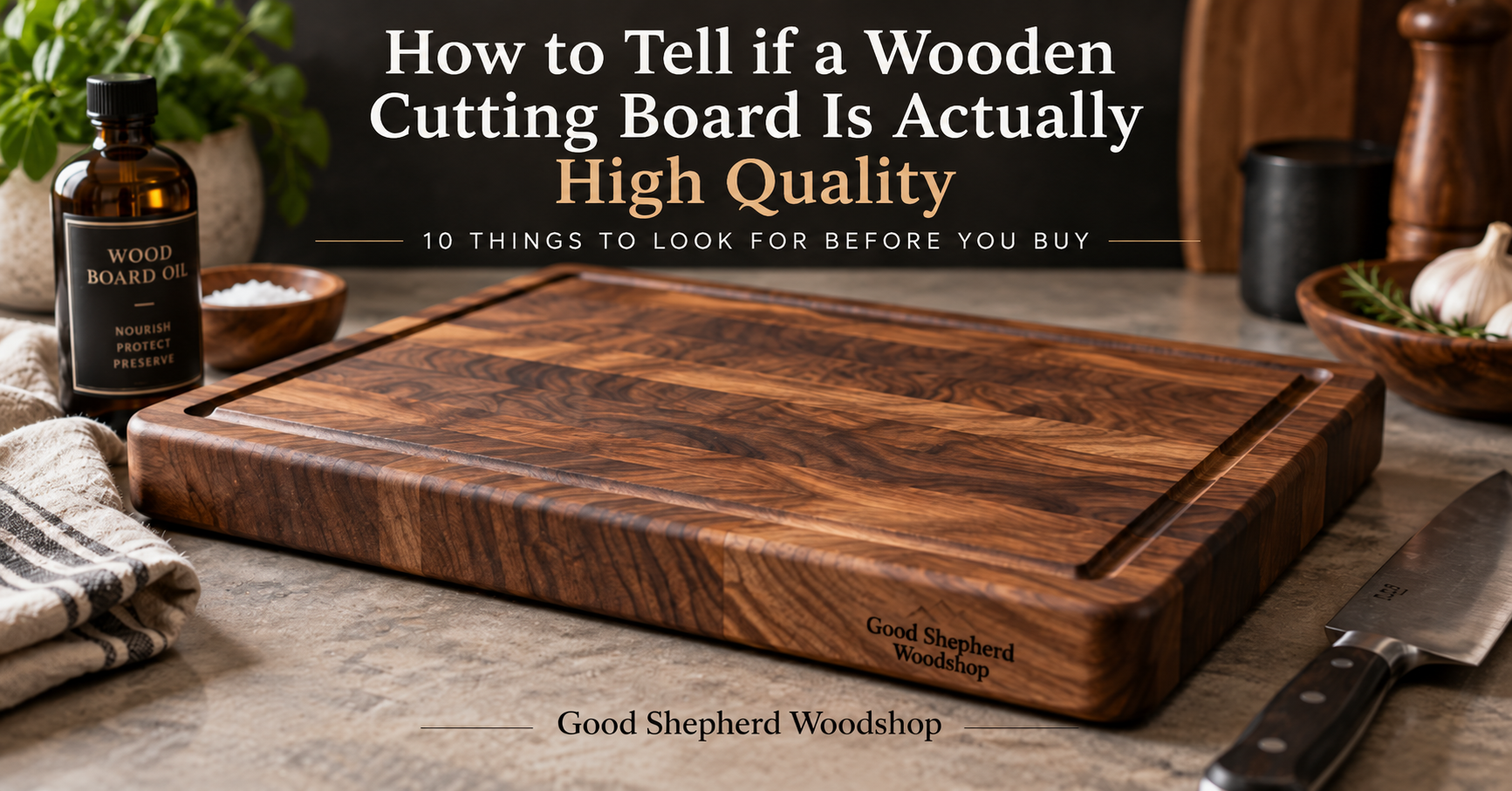
How to Tell if a Wooden Cutting Board Is Actually High Quality
Wooden cutting boards can range from inexpensive mass-produced boards to handcrafted pieces built to last for decades.
At first glance, they may all look similar.
But there can be a huge difference in the quality of the wood, construction, finish, and attention to detail.
If you're shopping for a wooden cutting board, here are a few things worth looking at before deciding which one to buy.
1. Look at the Wood Species
Not every hardwood is equally well suited for a cutting board.
Quality cutting boards are typically made from durable hardwoods such as:
Walnut
Maple
Cherry
Beech
These woods provide a good balance of durability and workability while creating a beautiful cutting surface.
Walnut is especially popular because of its rich brown color and natural variation.
Maple offers a lighter, more traditional appearance.
Cherry starts with a warmer reddish tone and tends to deepen in color over time.
Different woods create different looks, but the important thing is knowing exactly what your board is made from.
If a seller simply describes something as "natural wood" without identifying the species, that's worth questioning.
2. Pay Attention to Construction
A quality cutting board shouldn't simply look good on the day you purchase it.
It needs to stay together.
Wood naturally expands and contracts as humidity changes. Proper construction helps a cutting board handle that movement.
Look closely at the glue joints.
They should be tight and clean with no visible gaps between pieces of wood.
You also shouldn't see cracks or separation along the edges of the board.
Those small details can become much bigger problems after repeated washing and drying.
3. The Board Should Feel Substantial
Pick the board up.
A quality hardwood cutting board should generally feel solid.
That doesn't mean every good board needs to weigh 20 pounds, but an extremely thin or lightweight board may not provide the stability you want while chopping or carving.
Thickness is especially important on larger boards.
A large board that is too thin may be more prone to movement or warping.
A properly proportioned board should feel like something you can confidently work on rather than a decorative piece you need to be careful with.
4. Run Your Hand Across the Surface
The surface should feel smooth and consistent.
You shouldn't feel:
Deep sanding scratches
Rough grain
Sharp edges
Raised glue lines
Splinters
Handcrafted doesn't mean rough.
A premium handmade cutting board should actually receive more finishing attention than most mass-produced boards.
Small details such as softened edges and corners can make a surprisingly big difference in how the board feels every time you pick it up.
5. Look at the Finish
A cutting board shouldn't have a thick plastic-like coating sitting on top of the wood.
Instead, wooden cutting boards are generally finished with food-safe products designed to penetrate and protect the wood.
Mineral oil and cutting-board waxes are common examples.
A properly finished board should feel smooth and conditioned without feeling sticky or heavily coated.
The finish should also be something the owner can maintain over time.
Unlike a piece of furniture, a cutting board is a working surface. It will eventually need additional oil or conditioner.
That's normal.
6. Check the Details
Some of the biggest differences between an average board and a premium board are found in details that don't immediately jump out in a photograph.
Look at things like:
Corner consistency
Edge profiles
Juice grooves
Handles
Feet
Engraving
Logo placement
Overall symmetry
For example, a juice groove shouldn't simply be decorative.
It should be cleanly machined, smooth, consistent, and large enough to actually serve its purpose.
If the board includes handles, they should feel comfortable and make the board easier to move.
These aren't complicated features, but executing them well takes time.
7. Personalization Should Look Like Part of the Board
Custom engraving is one of the reasons people choose handcrafted cutting boards.
But there is a difference between adding a name to a cutting board and designing personalization that actually complements it.
Placement, size, orientation, and engraving depth all matter.
A family name, handwritten recipe, company logo, wedding date, or meaningful message should feel like it belongs on the board rather than something added as an afterthought.
That attention becomes especially important when the board is being given as a gift.
8. Ask Who Actually Made It
The word "handmade" gets used very loosely online.
Some businesses build every board themselves.
Others purchase finished boards and simply add engraving.
And some listings are mass-produced products being resold under a different name.
There isn't necessarily anything wrong with buying a mass-produced board.
Just understand what you're paying for.
If owning something genuinely handcrafted matters to you, ask where and how the board was made.
A woodworker who actually built the board should be able to tell you exactly what materials were used and how the board was constructed.
9. Consider Whether It Can Be Refinished
One of the best things about a quality hardwood cutting board is that normal wear doesn't necessarily mean the end of its life.
Knife marks, scratches, and surface wear are expected.
A solid hardwood board can often be sanded and refinished, giving it a fresh cutting surface again.
That's very different from many inexpensive kitchen products that are simply discarded once they begin looking worn.
A quality wooden cutting board should be something you maintain, not something you replace every year.
10. Don't Judge Quality by Price Alone
The most expensive cutting board isn't automatically the best.
At the same time, there's a reason a handcrafted hardwood cutting board costs more than a board sitting on a shelf at a big-box store.
You're paying for things such as:
Quality hardwood
Material selection
Milling and preparation
Multiple glue-ups
CNC or router work
Sanding
Finishing
Customization
Hands-on labor
A handcrafted board may go through many individual steps before it is ready to leave the shop.
That doesn't mean everyone needs an expensive custom cutting board.
But if you're comparing two boards with dramatically different prices, it's worth understanding what you're actually comparing.
Buy a Cutting Board for the Way You'll Use It
Ultimately, the best cutting board isn't simply the prettiest one.
It should be properly constructed, comfortable to use, appropriately sized, and built from materials suited to the job.
If you're buying something that you plan to use several times every week, quality matters.
And if you're purchasing a board as a wedding gift, housewarming gift, anniversary present, or family keepsake, craftsmanship becomes even more important.
Handcrafted Cutting Boards from Good Shepherd Woodshop
At Good Shepherd Woodshop, our cutting boards are handcrafted from premium hardwoods and built with attention to the small details that make a board enjoyable to use.
We offer ready-to-ship boards as well as custom sizes, designs, engraving, and other personalization options.
Whether you're looking for an everyday kitchen board, a large BBQ board, or a meaningful personalized gift, the goal is the same:
Build something beautiful enough to give as a gift and durable enough to actually use.
Browse our available cutting boards or contact Good Shepherd Woodshop to find the right board for you.

What Size Cutting Board Do I Need? A Guide to Choosing the Right Size
When shopping for a wooden cutting board, most people focus first on the wood species, color, or design.
But one of the most important decisions is actually much simpler:
What size cutting board do you need?
A board that is too small quickly becomes frustrating. Food ends up crowded together, chopped ingredients fall onto the counter, and larger cuts of meat barely fit.
A board that is unnecessarily large, on the other hand, can be difficult to wash, store, and move around the kitchen.
The right size depends on how you cook, what you prepare, and how much counter space you have.
Small Cutting Boards: Around 15”x12"
A smaller cutting board is great for quick everyday tasks.
This size works well for:
Cutting fruit
Slicing cheese
Preparing sandwiches
Chopping a few vegetables
Small meal prep
Bar or beverage use
Small boards are easy to grab, easy to wash, and easy to store.
For many households, a smaller board makes a great secondary cutting board even if you already own a larger one.
Medium Cutting Boards: Around 20" x 13"
For most everyday kitchens, this is where cutting boards start becoming much more versatile.
A board in this range gives you enough room to chop vegetables, prepare chicken, slice meats, and handle normal family meal preparation without taking over your entire countertop.
If someone asked us for a good all-around cutting board without giving us any other information, this would be a good size range to start considering.
Large Cutting Boards: Around 24" x 15" or Larger
If you regularly cook larger meals, you may appreciate considerably more workspace.
Large boards are especially useful for:
Brisket
Ribs
Roasts
Whole chickens
Large quantities of vegetables
Holiday meal preparation
Serious meal prep
One of the biggest advantages of a larger board is having enough room to keep working without constantly moving ingredients off the cutting surface.
If you have the counter space, a larger board can quickly become the board you use most often.
Brisket and BBQ Cutting Boards
BBQ deserves its own category.
If you're trimming, slicing, or serving a full brisket, a typical kitchen cutting board can feel very small very quickly.
For brisket and larger cuts of meat, we generally recommend looking at boards around 24" x 15" or similar dimensions.
That extra space gives you room for the meat itself while still leaving working space around it.
A juice groove can also be useful for catching juices during slicing and helping keep your countertop cleaner.
For anyone who regularly smokes brisket, ribs, pork shoulder, or other large cuts, a dedicated BBQ board can be one of the most useful additions to the kitchen.
How Thick Should a Cutting Board Be?
Size isn't just about length and width.
Thickness changes how a board looks and feels as well.
A thicker board feels substantial and tends to stay planted on the countertop while you're working.
It can also create the heavy, premium appearance people often associate with handcrafted butcher blocks.
However, thicker also means heavier.
If you plan to pull your cutting board out of a cabinet every time you use it, weight matters.
If the board will stay permanently on your countertop, a heavier board may actually be preferable.
Measure Your Counter Before Ordering
This sounds obvious, but it is worth doing.
Before ordering a large custom cutting board, measure the area where you expect to use it.
Pay attention to:
Counter depth
Distance between the backsplash and edge
Nearby appliances
Sink placement
Storage space
Where you plan to wash the board
A beautiful 24-inch cutting board isn't very useful if you discover that your countertop only gives you 21 inches of comfortable working space.
Should Your Cutting Board Stay on the Counter?
For larger handcrafted boards, many customers choose to leave the board on the countertop rather than storing it after every use.
In that situation, the cutting board becomes part of the kitchen.
That makes wood species and appearance more important because you'll see the board every day.
Walnut is especially popular because its darker color can create a warm, high-end look while still functioning as an everyday working surface.
Maple provides a lighter, cleaner appearance, while contrasting hardwoods can also be used to create unique designs.
Don't Forget the Sink
One thing people rarely think about when ordering a cutting board is how they're going to wash it.
Large boards generally shouldn't be submerged or soaked in water.
Instead, they can be washed by hand, rinsed, dried, and stored so that air can circulate around the board.
Still, you need enough room around your sink to comfortably clean it.
If you're considering an unusually large board, take a quick measurement of your sink area before deciding on your final dimensions.
What Size Cutting Board Is Best for a Gift?
If you're buying a cutting board as a wedding, housewarming, anniversary, or holiday gift, a medium-size board is usually the safest choice.
It provides enough working space to be useful without assuming the recipient has a huge kitchen.
Personalization can also turn a practical kitchen tool into something much more meaningful.
Names, dates, logos, family recipes, handwriting, and other designs can often be incorporated into a custom board.
Custom Sizes Can Make a Big Difference
One advantage of purchasing a handcrafted cutting board is that you're not limited to standard store-bought dimensions.
Sometimes the best cutting board isn't 20"x13" or 24"x15".
Maybe you have a specific section of countertop you want to fill.
Maybe you need something large enough for brisket.
Maybe you're replacing a board designed to fit into a particular kitchen space.
Or maybe you simply want something nobody else has.
That's where custom sizing becomes valuable.
Finding the Right Cutting Board
There isn't one perfect cutting board size for everyone.
For quick prep, a smaller board may be all you need.
For everyday cooking, a medium-size board provides a great balance.
For BBQ, large meals, or people who simply enjoy having plenty of workspace, a larger board is usually worth it.
The important thing is choosing a board based on how you're actually going to use it rather than simply buying whatever size happens to be sitting on a store shelf.
Handmade Cutting Boards from Good Shepherd Woodshop
At Good Shepherd Woodshop, we build handcrafted wooden cutting boards in a variety of sizes, woods, and designs.
Whether you're looking for a compact everyday board, a large brisket board, a personalized gift, or a cutting board built specifically for your kitchen, we can help you choose dimensions that make sense for how you'll use it.
Browse our available cutting boards or contact Good Shepherd Woodshop to discuss a custom board.
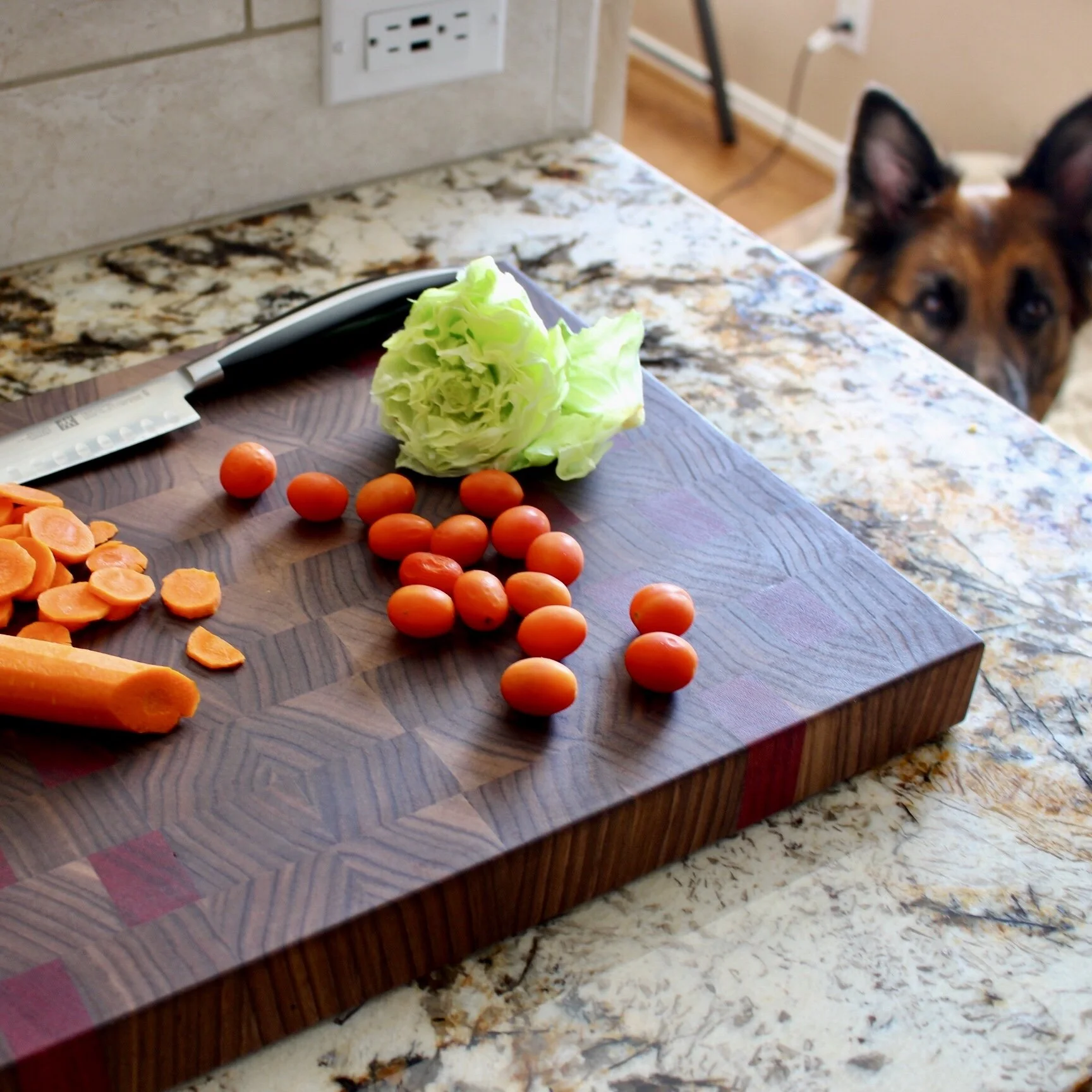
How to Care for a Wooden Cutting Board
A handcrafted hardwood cutting board is built to last for generations — but like any natural material, it needs a little care to stay in top shape. Here’s everything you need to know to keep your board looking beautiful and performing well for years to come.
Daily Cleaning
After each use, wash your board with warm water and a mild dish soap, then dry it immediately with a clean towel. Avoid soaking your board or leaving it wet in the sink — standing water is the fastest way to warp or crack wood over time.
Never put a wooden cutting board in the dishwasher. The combination of prolonged water exposure and high heat will cause the wood to warp, crack, or split.
Storing Your Board
Always store your board standing on its edge, or flat if it has rubber feet, so air can circulate on both sides. Storing a board flat against a counter without feet traps moisture underneath and can cause uneven warping.
Oiling and Conditioning
Wood is porous, and regular oiling keeps it from drying out, cracking, or absorbing odors and stains.
New boards should be oiled several times in the first few weeks to fully saturate the wood.
After that, oil your board once a month for regular use, or whenever the wood starts to look dry or dull.
Use a food-safe mineral oil or a specialized board oil — avoid olive oil, vegetable oil, or other cooking oils, which can go rancid over time.
Apply a generous amount, let it soak in for a few hours (or overnight), then wipe away any excess with a clean cloth.
Handling Stains and Odors
For light stains or lingering smells, sprinkle coarse salt or baking soda on the surface, scrub gently with half a lemon, then rinse and dry as usual. This natural method lifts stains and neutralizes odors without harsh chemicals.
What to Avoid
Soaking in water or running through the dishwasher
Direct sunlight or heat sources (near a stove or in a hot car), which can cause warping
Cutting boards left wet for extended periods
Cooking oils in place of food-safe mineral oil
A Board Built to Last
With a little routine care, a handcrafted hardwood board only gets more beautiful with age — the grain deepens, the patina develops, and it becomes a piece you’ll pass down for years. Every board from Good Shepherd Woodshop comes with a bottle of board oil and a care card to help you get started.
Have a specific care question, or curious which wood species holds up best for your kitchen? Reach out to us — we’re happy to help.
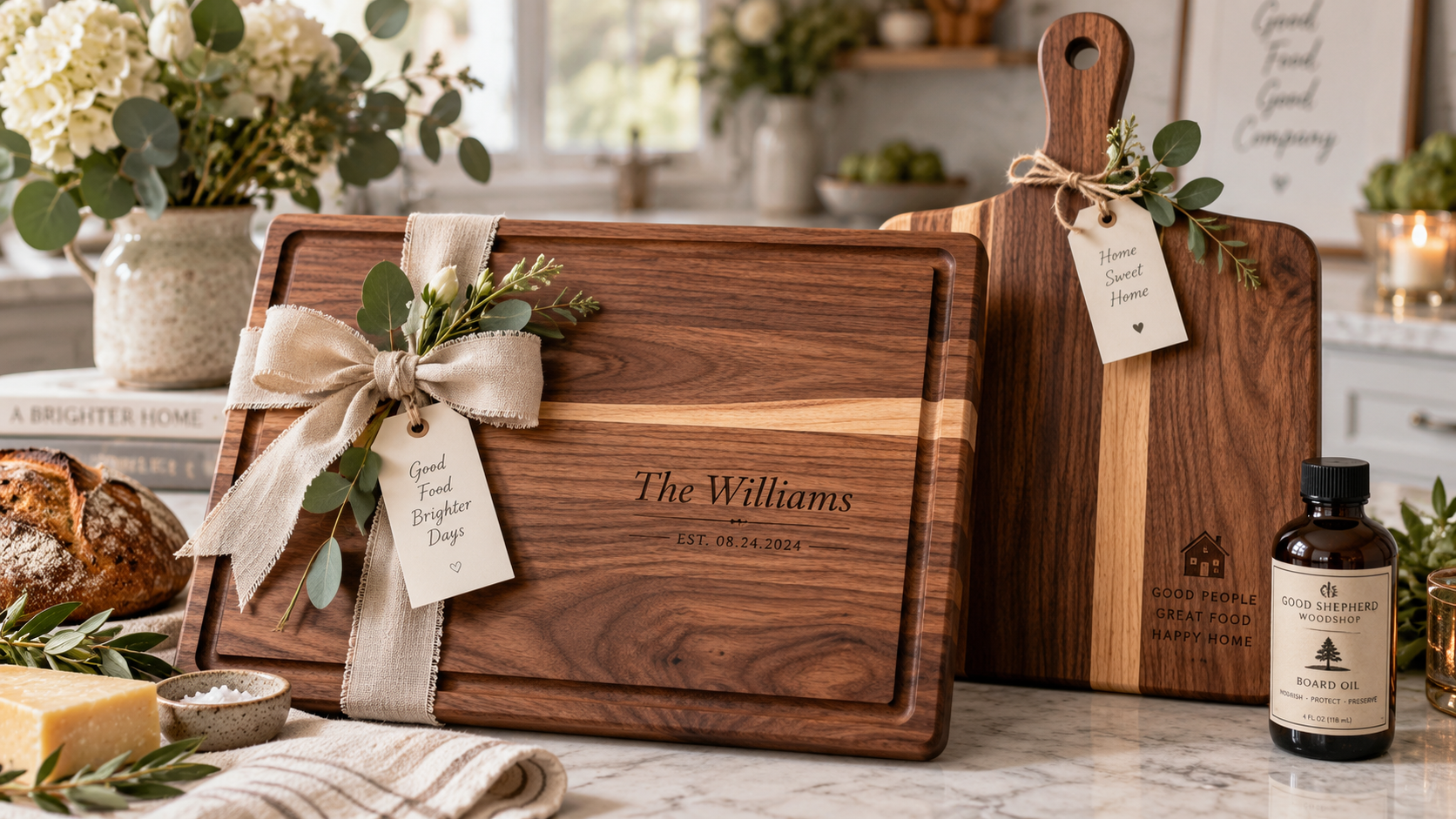
Gift Guide: Best Custom Cutting Boards for Weddings & Housewarmings
Gift Guide: Best Custom Cutting Boards for Weddings & Housewarmings
Finding a gift that feels personal, useful, and built to last isn’t always easy — especially for milestone moments like weddings and new homes. A handcrafted cutting board checks every box: it’s functional, beautiful, and can be customized to make it truly one-of-a-kind. Here’s how to pick the right one.
For Weddings
A cutting board makes a timeless wedding gift because it’s something a couple will actually use for decades, not something that ends up in a closet. A few ways to make it extra special:
Add custom engraving with the couple’s names and wedding date for a keepsake they’ll treasure
Go with a larger size, like our Brisket or Turkey boards, so it can double as a serving centerpiece for future dinner parties and holidays
Consider a two-tone wood combination (like walnut and maple) for a striking, elegant look that fits any kitchen style
For Housewarmings
When someone’s settling into a new home, a cutting board is both a practical essential and a warm, welcoming gesture.
Mid-size boards, like our Chicken or Tomahawk sizes, are the most functional for everyday use in a new kitchen
Epoxy resin serving boards add a bold, modern touch if you know the recipient’s style leans contemporary
Pair it with a bottle of board oil (included with every purchase) so they can start caring for it right away
For the Home Cook or Griller in Your Life
If you’re shopping for someone who loves to cook — or spends their weekends smoking a brisket — our larger butcher block sizes are built specifically for that kind of heavy, everyday use. The Brisket and Titan sizes offer enough surface area for serious meal prep or breaking down a full cut of meat.
Why a Handcrafted Board Makes a Better Gift
Every board we make is one-of-a-kind, crafted from sustainably sourced hardwoods with no two grain patterns exactly alike. Unlike mass-produced kitchenware, a custom board says you put real thought into the gift — and it only gets more beautiful with age and use.
Plus, a portion of every purchase supports animal rescue organizations, so your gift gives back in more ways than one.
Ready to Find the Perfect Board?
Browse our full collection, explore sizes and options to find the right fit, or reach out if you’d like help designing a custom piece for someone special.